Kenai Fjords Wildlife: What You'll See on a Cruise
The complete field guide to Kenai Fjords wildlife — otters, whales, sea lions, puffins, mountain goats and bears you'll see on a Seward wildlife cruise.
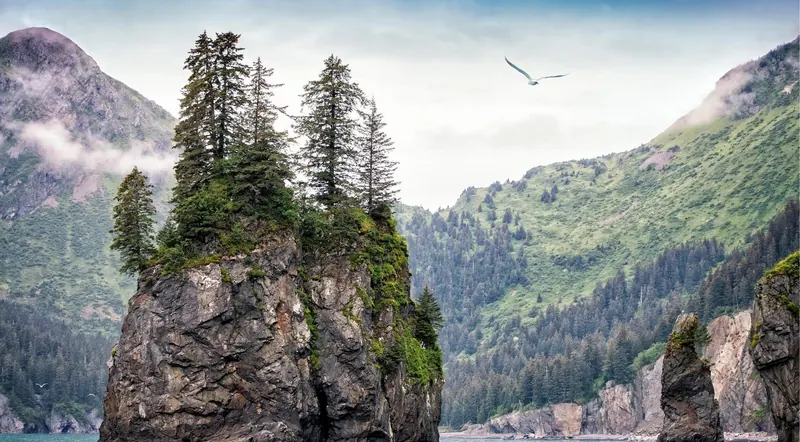
Kenai Fjords National Park is one of the great wildlife strongholds of the North Pacific, and a day cruise from Seward is the single best way to see it. In a few hours on the water you can watch sea otters cracking clams on their chests, Steller sea lions hauled out on wave-battered rocks, harbor seals resting on floating glacier ice, puffins whirring past the bow, and — if the day delivers — humpback whales and orcas breaking the surface. The park protects 669,984 acres where the Harding Icefield meets the Gulf of Alaska, and its narrow band of life between ice and ocean concentrates animals into a compact, reachable stretch of coast.
This is the broad field guide to everything you might see: every marine mammal, seabird and land animal, where and when to look, which cruise gives you the best odds, and how to watch responsibly. For a deep dive on cetaceans specifically, see our dedicated whale watching guide; this article keeps whales concise and covers the whole cast.
Wildlife is never guaranteed, and no honest operator will promise you a whale. What you can check before you book is which boats are running and when:
Wildlife at a glance
| Animal | Where you’ll see it | When | Likelihood on a cruise |
|---|---|---|---|
| Sea otter | Seward harbor, Resurrection Bay, sheltered coves | All season | Very high |
| Steller sea lion | Chiswell Islands, Cape Resurrection haul-outs | All season | High |
| Harbor seal | Ice near Aialik & Northwestern glaciers | May–Sept | High (on glacier cruises) |
| Bald eagle | Shorelines, spruce tops, cliffs | All season | Very high |
| Puffins (horned & tufted) | Chiswell Islands, rocky sea cliffs | ~May–late Aug | High (full-day cruises) |
| Common murre / kittiwake | Nesting cliffs, Chiswells | May–Aug | High (full-day cruises) |
| Dall’s porpoise | Open water, bow of the boat | All season | Moderate–high |
| Humpback whale | Open water, fjord mouths | May–Oct | Moderate–high |
| Orca | Resurrection Bay, outer coast | Year-round; best mid-May–June (Major Marine) | Moderate |
| Mountain goat | Cliffs above the fjords (“goat alley”) | All season | Moderate–high |
| Gray whale | Gulf entrance, outer coast | April–May | Seasonal only |
| Black bear | Shoreline, avalanche chutes, Exit Glacier | Late spring–summer | Low–moderate |
Sightings are never guaranteed, but the fjords funnel a large variety of wildlife into a small area, so the odds are genuinely high — especially on longer cruises that reach the open water and the Chiswell Islands.
Other experiences you might enjoy
A guided sea kayak paddle in Resurrection Bay gets you level with otters and seals, and a hike at Exit Glacier offers black bears and marmots.
Marine mammals
Sea otters
Sea otters are the animal you’ll almost certainly see, often within minutes of leaving the dock. The northern sea otter (Enhydra lutris) is common right in the Seward small boat harbor and throughout Resurrection Bay, floating belly-up in loose groups called rafts, grooming constantly and cracking shellfish on their chests. They are the largest members of the weasel family but carry no blubber; instead they rely on the densest fur of any mammal — on the order of a million hairs per square inch — which is exactly why 18th- and 19th-century fur hunters nearly wiped them out across the North Pacific. Protected since the early 20th century, the Southcentral Alaska population has recovered and is considered stable, and Kenai Fjords now holds one of the largest sea otter populations in the national park system. Mothers carry pups on their bellies; a pup’s fur is so buoyant it cannot dive until it grows in its adult coat. Look for them in protected coves and kelp near shore.
Steller sea lions
The Steller sea lion is the largest of the “eared seals,” and the bulls are enormous — per NOAA Fisheries, adult males may reach about 11 feet long and weigh up to 2,500 pounds (roughly 1,130 kg). You’ll see and hear them at haul-outs and rookeries on exposed rock, especially in the Chiswell Islands and near Cape Resurrection at the mouth of Resurrection Bay, where they hiss, belch and jostle for space. The western distinct population segment (DPS) — which includes all animals in the Kenai Fjords region — remains listed as endangered under the Endangered Species Act after unexplained declines of roughly 77–81% from the 1970s to the early 2000s; the eastern DPS has recovered and was delisted in 2013. All major Alaskan rookeries and haul-outs are protected, so boats keep their distance.
Harbor seals
Harbor seals are the round-headed seals you’ll see bobbing almost anywhere, but Kenai Fjords offers something special: they haul out on floating ice calved from the tidewater glaciers at Aialik Bay and Northwestern Fjord. That glacier ice is essential nursery habitat — females pup and molt on the floes in early summer, and pups rely entirely on their mothers for nutrition and warmth. The population that uses Aialik’s ice has declined sharply: according to Hoover-Miller et al. (2011, Marine Ecology Progress Series 424:259–271), the number of harbor seals using glacial ice adjacent to Aialik Glacier declined by 93% from 1979 to 2009 — part of a broader concern about ice-dependent seals in a warming climate. Because a single vessel can flush a large fraction of a haul-out into the cold water, NOAA has specific viewing guidance for glacial fjords (below). If you take a glacier cruise, this is your best chance to see seals resting on ice.
Whales (humpback, orca, gray, fin, minke)
Whales get their own full guide, so here’s the short version. Humpback whales migrate up from Hawaii and Mexico to feed in the fjords from mid-April until November, according to the National Park Service, sometimes cooperatively bubble-net feeding on schools of forage fish. Orcas (killer whales) appear year-round, but Major Marine names mid-May to June as its best orca viewing; you may see fish-eating “resident” pods or, more rarely, mammal-hunting “transients.” Gray whales pass on their spring migration, best in April and May — the one genuinely different, early-season trip. Fin whales (the second-largest animal on Earth) and minke whales turn up occasionally in open water. For behaviour, identification and the best whale cruises, see the whale watching article.
Dall’s porpoise
The Dall’s porpoise is a crowd favourite: a compact, muscular black-and-white porpoise that rivals the orca as the fastest marine mammal in Alaska waters, throwing up a distinctive “rooster tail” of spray as it surfaces. They love to bow-ride, sidling up to the boat to surf the pressure wave off the hull. Their bold markings mean they’re routinely mistaken for baby orcas — but their dorsal fin is small and triangular and they lack the orca’s eye and saddle patches. Watch the bow in open water.
Harbor porpoise
The harbor porpoise is smaller, greyer and far shyer — no bow-riding, no rooster tail. You’ll spot one only in calm seas when its small rounded back rolls quietly at the surface. Easy to miss, and a nice catch when you get one.
Seabirds and birds
191 bird species have been documented in Kenai Fjords (per the National Park Service; a broader NPS-derived list totals 226 when probably-present, unconfirmed and adjacent species are included), and the park is recognised as an Important Bird Area. The star attraction is the seabird spectacle of the Chiswell Islands.
Puffins — horned and tufted
Two puffin species breed here, present roughly May through August and largely gone by late August. The horned puffin has the classic white face and belly and a thick yellow-and-orange bill, plus a small fleshy black “horn” above each eye in breeding season — the puffin on all the Alaska souvenirs. The tufted puffin is all-dark-bodied with a white face mask and long golden head tufts curling back over the ear in breeding plumage. Both are about 14 inches long, dig or occupy nest burrows and rock crevices on islands, and “fly” underwater with their wings to chase fish, sometimes carrying a dozen or more crosswise in the bill. Look for them at the Chiswell Islands and other rocky rookeries.
Murres and kittiwakes
The common murre nests in dense, cacophonous colonies on cliff ledges — black-and-white, upright, penguin-like — alongside the less common thick-billed murre. The black-legged kittiwake is a dainty cliff-nesting gull that packs narrow ledges by the thousand and wheels over bait balls at the surface; watching a colony pour off the cliffs in unison is one of the great sights of the fjords. Both are best seen on full-day cruises that reach the Chiswells.
Bald eagles
Bald eagles are common and present year-round, perched on spruce tops and shoreline snags or soaring the cliffs. Kenai Fjords supports large breeding populations that depend heavily on marine resources; NPS monitors coastal nests along the park’s roughly 500 miles of coastline (a 2012 survey of about 190 miles of coast found 76 nests, 57% occupied by incubating adults). You’ll very likely see several on any cruise.
Other birds to watch for
Scan the water and cliffs for the rhinoceros auklet (a stocky puffin relative, grey with a pale “horn” and white face plumes in breeding season, common on whale-watching tours), the inshore pigeon guillemot (black with white wing patches and vivid scarlet feet, foraging close to shore), and the marbled murrelet and rare Kittlitz’s murrelet (the latter a “holy grail” of the far Northwestern Fjord). Add pelagic, double-crested and red-faced cormorants (the Pacific specialty red-faced sports a cherry-red face in summer), several gull species, the striking black oystercatcher (black with a long red bill, working the intertidal rocks), the harlequin duck (drakes are slate-blue with white crescents and chestnut sides), and common loons in the bays. The 8.5-hour Northwestern Fjord cruise is the birder’s choice for the fullest list.
Land mammals
Mountain goats
Mountain goats are the land animal you’re most likely to see from the boat, appearing as white dots on impossibly steep green cliffs above the fjords. Guides have nicknamed the western shore of outer Resurrection Bay, between Caines Head and Callisto Head, “goat alley” because the animals are so reliably found there, sometimes perched on ledges just above the sea; nannies even give birth on the shoreline in late May and early June. Later in summer they climb higher. Bring binoculars and let the crew point out the white specks.
Mountain goats vs. Dall sheep — an accuracy note
It’s a common mix-up, so be clear: the white ungulate you see on Kenai Fjords cliffs is the mountain goat, not a Dall sheep. Mountain goats favour the steep, wet coastal cliffs of Southeast and Southcentral Alaska; Dall sheep prefer drier interior alpine country and are essentially not what you’ll see on a fjords cruise. Mountain goats have short black horns, shaggy white coats and a beard; Dall sheep rams have massive curling amber horns.
Black bears, moose and marmots
Black bears forage along the shoreline and on avalanche chutes and are sometimes spotted from the boat, though because so much of the coast is inaccessible, sightings are a matter of luck. They’re most reliably seen in the Exit Glacier area of the park, where they feed on salmonberries along the Harding Icefield Trail. Moose browse the willow of the Exit Glacier lowlands and roadsides — a land-based sighting, not a cruise one. Hikers on the Harding Icefield Trail often hear and see the hoary marmot, a large alpine rodent with a piercing warning whistle. Rarer residents include coyote, grey wolf, wolverine, lynx, porcupine and river otter — present but seldom seen. For land-based wildlife, pair your cruise with the glaciers and Exit Glacier guide.
Our picks for the land side. The Exit Glacier Nature Hike (from $67, 4.7 from 29 reviews) is the easy guided walk along the outwash plain, where moose and the occasional black bear turn up. The Harding Icefield Trail Hiking Tour (from $342, 5.0 from 12 reviews — a small sample, so read them) is the strenuous full-day climb, and the most reliable place in the park to hear a hoary marmot and see bears working the salmonberries.
Bear viewing near Seward: an honest assessment
This deserves plain talk, because it’s the most misunderstood wildlife question in Seward. Kenai Fjords and Seward are not a dedicated brown/grizzly bear-viewing destination. The bear you might see on a Kenai Fjords cruise is the black bear, glimpsed foraging on a distant shoreline, and even that is a bonus rather than an expectation. There is no Brooks Falls here.
Genuine, reliable brown bear viewing — the famous scenes of bears catching salmon and digging clams — requires a fly-in trip to places like Katmai (Brooks Falls), Lake Clark, Chinitna Bay or Redoubt Bay. Those trips depart from Homer, Anchorage, or Kenai/Soldotna, not from Seward, and they are separate excursions involving a small floatplane. If bears are a priority, plan a dedicated fly-out bear day from one of those hubs and treat your Kenai Fjords cruise as the marine-wildlife-and-glaciers experience it does best. Don’t book a Seward boat tour expecting brown bears — you’ll see otters, sea lions, seals, whales, puffins and goats instead, which is a spectacular day in its own right. See the Seward things-to-do guide for how to fit a bear day into an itinerary.
Why Kenai Fjords is so wildlife-rich
The abundance isn’t an accident. Kenai Fjords sits at the edge of the Gulf of Alaska, where cold, nutrient-rich water and regional currents drive an early, intense spring plankton bloom in outer Resurrection Bay. That plankton feeds enormous schools of oily forage fish — Pacific herring, capelin and sand lance — plus juvenile salmon, and those small schooling fish are the pivot of the whole food web. Everything above them — puffins and murres, sea lions and seals, humpbacks and orcas — is ultimately eating forage fish or the salmon that eat them.
Meanwhile the glaciers add freshwater and float the ice that harbor seals use as a nursery, and the sheer sea cliffs of the Chiswell Islands — part of the Alaska Maritime National Wildlife Refuge — give hundreds of thousands of seabirds predator-free ledges to nest on. The Chiswells are the most-visited seabird colonies of that refuge, and they are the reason a Seward cruise can show you a true seabird city. It’s a narrow, productive band of life squeezed between ice and ocean, which is exactly why it’s so easy to see so much in one day.
Where and when to see wildlife
By zone:
- Seward harbor and inner Resurrection Bay: sea otters, bald eagles, sometimes harbor seals — right away.
- Outer Resurrection Bay / “goat alley” (Caines Head–Callisto Head): mountain goats on the cliffs, more otters, murres and guillemots.
- Cape Resurrection and the bay mouth: Steller sea lion haul-outs, seabird cliffs, open-water whales and Dall’s porpoise.
- Chiswell Islands (Alaska Maritime NWR): the seabird spectacle — puffins, murres, kittiwakes — and sea lion rookeries.
- Aialik Bay and Northwestern Fjord: harbor seals on glacier ice, tidewater glaciers, deep-fjord birds.
- Exit Glacier area (land): black bears, moose, marmots — reached by road, not by boat.
By season: Gray whales pass April–May; orcas are seen most often from mid-May to June; puffins and the full seabird show run roughly May to late August; humpbacks build through summer and stay to October; otters, sea lions, seals, eagles and goats are present all season. See our best time to visit guide for a month-by-month breakdown.
Which cruise to book for wildlife
The rule of thumb is simple: more time on the water means more wildlife. Seward operators offer a ladder of tour lengths, and the longer ones reach the richest habitat.
- 4-hour Resurrection Bay wildlife cruise: stays in the protected bay — also the best pick if you’re prone to seasickness — otters, eagles, goats, often whales, a good family and short-on-time option. Major Marine Tours states it sees whales on about 75% of these 4-hour cruises between June and mid-August — see the caveat below.
- 6-hour cruise: the popular middle option, reaching into the park and a tidewater glacier; good for Anchorage day-trippers.
- 7.5-hour cruise: more glacier and wildlife time on a large, stable catamaran, typically visiting two tidewater glaciers.
- 8.5-hour Northwestern Fjord cruise: the small-vessel adventure that travels farthest, reaching the Chiswell Islands and remote Northwestern Fjord — operators call it their best cruise for wildlife, and it’s the top pick for birders and photographers.
Matching that ladder to what you can book here. The listings below are grouped by itinerary rather than by a promised hour count, because exact durations vary by operator and season — check the listing before you book:
| If you want | Book | Live rating |
|---|---|---|
| Half-day in Resurrection Bay | Resurrection Bay Half-Day Sightseeing Cruise — from $150 | 4.7 from 99 reviews |
| A full day in the park, wildlife-billed | Kenai Fjords Glacier & Wildlife Cruise — from $230 | 4.8 from 202 reviews |
| A full day, most-proven option | Kenai Fjords Glacier Cruise with Lunch — from $287 | 4.8 from 948 reviews |
| A longer day, two tidewater glaciers | Kenai Fjords Extended Glacier Cruise — from $319 | 4.9 from 491 reviews |
| The farthest, best-for-birders trip | Full-Day Northwestern Fjord Glacier & Wildlife Tour — from $288 | 4.9 from 43 reviews |
| Let the captain chase the wildlife | Captain’s Choice Kenai Fjords Tour — from $255 | 5.0 from 34 reviews |
The Glacier Cruise with Lunch is the safest all-round wildlife pick simply because 948 people have rated it — by a wide margin the largest verified sample in the park. The Northwestern Fjord and Captain’s Choice trips score higher but on far smaller samples (43 and 34 reviews); they’re excellent, and the ratings are real, but a 5.0 from 34 people and a 4.8 from 948 are not the same claim.
Vessel choice matters too. Large catamarans are stable, heated and comfortable in swell; smaller vessels are more nimble, carry fewer people, and get closer to shore and ice. For the closest, quietest encounters of all, consider sea kayaking, where you’re at eye level with otters and seals. Note the practical booking details in the boat tours guide, weigh the trade-offs in our half-day vs. full-day comparison, and see how the companies differ in our operators compared breakdown. If you’re coming from the city, the Anchorage day trip guide explains how to make a cruise work in one day.
One factual note for planning: per the National Park Service (updated September 2025), NPS has no authorized concessioners and no rangers aboard the tour boats — narration on all cruises is provided by the operators’ own captains and naturalists, who are expert at finding and identifying wildlife.
Responsible wildlife viewing
Alaska’s marine mammals are protected under the Marine Mammal Protection Act, and responsible operators keep their distance — both because it’s the law and because disturbance harms animals. Key rules and guidance:
- Whales: Federal law requires vessels to stay at least 100 yards from humpback whales in Alaska waters (in effect since July 2001), and NOAA recommends 100 yards from all marine mammals as a general code of conduct, limiting viewing to 30 minutes.
- Harbor seals on glacial ice: NOAA’s voluntary glacial-fjord guidelines ask boats to stay 500 yards (about a quarter mile) from hauled-out seals, avoid wakes and abrupt noise, and avoid travelling through water with more than 50% ice cover — because a single ship can flush a large share of a haul-out, and flushed pups risk cold stress and separation.
- Sea lions and seals generally: stay at least 50–100 yards from haul-outs and rookeries and never cause animals to stampede into the water. All major Steller sea lion rookeries and haul-outs are protected areas.
- Bears on shore: if you’re hiking near Exit Glacier, carry bear spray, make noise and give bears wide berth.
- Ethical photography: never ask a captain to chase or crowd an animal; a good sighting is one the animal barely notices.
Curious animals sometimes approach the boat on their own — that’s fine and legal — but the vessel should not pursue. Many Seward operators are members of NOAA’s Whale SENSE responsible-viewing programme.
Photography and spotting tips
- Bring binoculars (many full-day boats provide them) and, if you shoot, a telephoto lens — 300mm or more helps for distant goats, birds and blows.
- Learn the cues. Whales announce themselves with a blow (a puff of spray); otters look like floating lumps of kelp; goats are white dots on green cliffs; sea lions are loud before you see them; and swirling, diving flocks of gulls and kittiwakes mark a bait ball — often with whales or porpoises underneath.
- Watch the crew. When a captain or deckhand calls a direction (they use clock positions — “whale at two o’clock”), look fast; sightings can be brief.
- Shoot from a moving boat with a fast shutter speed (1/1000s or faster), brace against the rail and shoot bursts. Keep both eyes open to reacquire fast animals like Dall’s porpoise.
- Light and weather: mornings are often calmer with better spotting; overcast “bad” weather is frequently the best for seabirds and cuts glare on the water. Dress warm — the best viewing is out on deck.
Wildlife by month (quick reference)
| Month | What’s around and peaking |
|---|---|
| March | Winter/early boat access only; sea otters, eagles; gray whales begin at the Gulf entrance late month |
| April | Gray whale migration; otters, sea lions, eagles; land still in winter mode |
| May | Season opens; humpbacks arrive, orcas excellent mid-month on, puffins and seabirds return, goats kidding on shore |
| June | Arguably the best month; orca peak through mid-month, long days, full seabird colonies, otters and seals with pups |
| July | Peak summer; humpbacks feeding actively, otters and puffins everywhere, all cruises running |
| August | Strong whale activity early; puffins begin leaving by late month; thinning crowds |
| September | Shoulder season; whales still around, seabirds mostly gone, moody light, fewer boats |
Frequently asked questions
What animals will I see in Kenai Fjords? Realistically: sea otters, bald eagles, Steller sea lions, harbor seals and mountain goats on most full cruises, plus puffins and cliff-nesting seabirds on trips that reach the Chiswell Islands, and a good chance of whales or Dall’s porpoise. Black bears and moose are occasional bonuses.
Are you guaranteed to see wildlife? No responsible operator guarantees specific sightings. But the fjords concentrate wildlife, so otters, eagles, sea lions and seabirds are near-certain on a full-day trip, and whale odds are high in summer. Major Marine Tours, for example, states it sees whales on about 75% of its 4-hour cruises between June and mid-August, while stressing sightings aren’t guaranteed; Kenai Fjords Tours similarly notes sightings “can never be guaranteed.”
Can you see bears in Kenai Fjords? Sometimes — black bears forage along the shoreline and are occasionally seen from the boat, and more reliably near Exit Glacier. They are never guaranteed, and this is not brown-bear country.
Where can I see brown bears near Seward? Not from a Seward boat tour. Reliable brown/grizzly viewing means a fly-out trip to Katmai, Lake Clark, Chinitna Bay or Redoubt Bay, departing from Homer, Anchorage, or Kenai/Soldotna — a separate excursion.
When do puffins arrive? Both horned and tufted puffins are generally present from around May through August at their breeding colonies, and mostly gone by late August.
What’s the best cruise for wildlife? The longest one you have time for. The 8.5-hour Northwestern Fjord cruise reaches the Chiswell Islands and open water and is billed as the best for wildlife and birding; the 6- and 7.5-hour cruises are excellent all-rounders.
Do you see sea otters? Almost always — they’re common right in Seward harbor and throughout Resurrection Bay, often the first animal you see.
Are there whales? Yes — humpbacks (May–October) and orcas (most often seen mid-May to June) are the headliners, with gray whales in spring and occasional fin and minke whales. See the whale watching guide.
What land animals live there? Mountain goats (seen from the boat), black bears, moose, hoary marmots, plus rarely seen wolves, coyotes, wolverines, lynx, porcupines and river otters. Dall sheep are essentially not present.
When is the best time for wildlife? June and July for the fullest mix and best conditions; mid-May to June for orcas; April–May if gray whales are your goal. See best time to visit.
Do you see wildlife from a kayak? Yes, and often at close range and eye level — otters, seals and seabirds especially. It’s quieter and more intimate than a big boat; see our kayaking guide.
How close do boats get to animals? As close as the law and good ethics allow — at least 100 yards from whales and up to 500 yards from seals on glacial ice — though curious otters, porpoises and sea lions sometimes approach the boat on their own.
Kenai Fjords packs an astonishing amount of wildlife into a single day on the water, from the otter in the harbor to the sea lion rookery at the edge of the Gulf. Choose a cruise length that matches your priorities, bring binoculars and layers — our packing guide has the full list — and let the captains do the spotting. Ready to plan? Start with the pillar park guide and the boat tours overview. For how the park stacks up against alternatives, see our Kenai Fjords vs. Glacier Bay comparison; for a bird’s-eye add-on, the helicopter and flightseeing guide; and for lodging, where to stay in Seward.
See a Glacier Calve Into the Sea
The most-booked cruise in Kenai Fjords National Park — more than 940 guests, 4.8 out of 5. A tidewater glacier, a deli lunch on board, and free cancellation up to 24 hours before you sail.
Check Availability & Book